

### Blog Post:
Dishwasher Drawer units are changing how small apartments and city kitchens use space, but should you choose one over a standard dishwasher? Before you commit, here’s a candid, real-world look at fit, installation, true savings, and potential headaches—so you make the right call for your home and budget.
Key Takeaways
- Dishwasher drawers are compact and energy efficient but come with higher upfront and installation costs compared to standard under-counter models.
- They’re best for singles or couples in small kitchens who often run smaller loads and value space more than maximum capacity.
- Expect to modify cabinetry and plan for specialized plumbing and electrical—confirm fit and installation details before buying.
- Quick Verdict — Can a Dishwasher Drawer Replace a Standard Dishwasher in an Apartment?
- 2024–2026 Market Adoption & Energy Efficiency Trends for Small Apartments
- Real‑World Performance: What Verified Fisher & Paykel Owners Report
- Conclusion & Next Steps
- Dishwasher Drawer FAQ
Quick Verdict — Can a Dishwasher Drawer Replace a Standard Dishwasher in an Apartment?
If you have a small household (one or two people), mostly use regular dinnerware and want to maximize cabinet space, a dishwasher drawer is a viable—sometimes ideal—alternative to a standard 24-inch dishwasher. If you’re budget-conscious, prepare for a higher purchase price and potential professional installation. For larger families or frequent cooks with big pots and pans, standard dishwashers still win on sheer capacity and lower cost.

Here’s the tradeoff: drawer dishwashers save space and can cut water/energy use for small, frequent loads, but their upfront and install costs are higher, capacity is lower, and service needs may be more frequent. By 2026, dishwasher drawer models are projected to reach 10–15% of the market, but standard 24-inch tubs still make up 40–45% of sales and remain the default in most small-apartment installs (source).
2024–2026 Market Adoption & Energy Efficiency Trends for Small Apartments
Drawer-style dishwashers are finally gaining ground due to two trends: more urban renters, and increasing demand for flexible, space-saving, and energy-efficient appliances. Brands like Fisher & Paykel are fueling this rise with models built for tight spaces and small, frequent loads (source).
From 2024 to 2026, drawer-style dishwashers are moving from niche to mainstream, with market share estimated to jump from single digits to 10–15% (source). Most models promote impressive eco-claims: Consumer Reports lab tests find drawer designs usually use a little more water and energy than stated (often just a few dollars more per year), but they still outperform full-size models if you rarely, if ever, fill a standard tub (source).
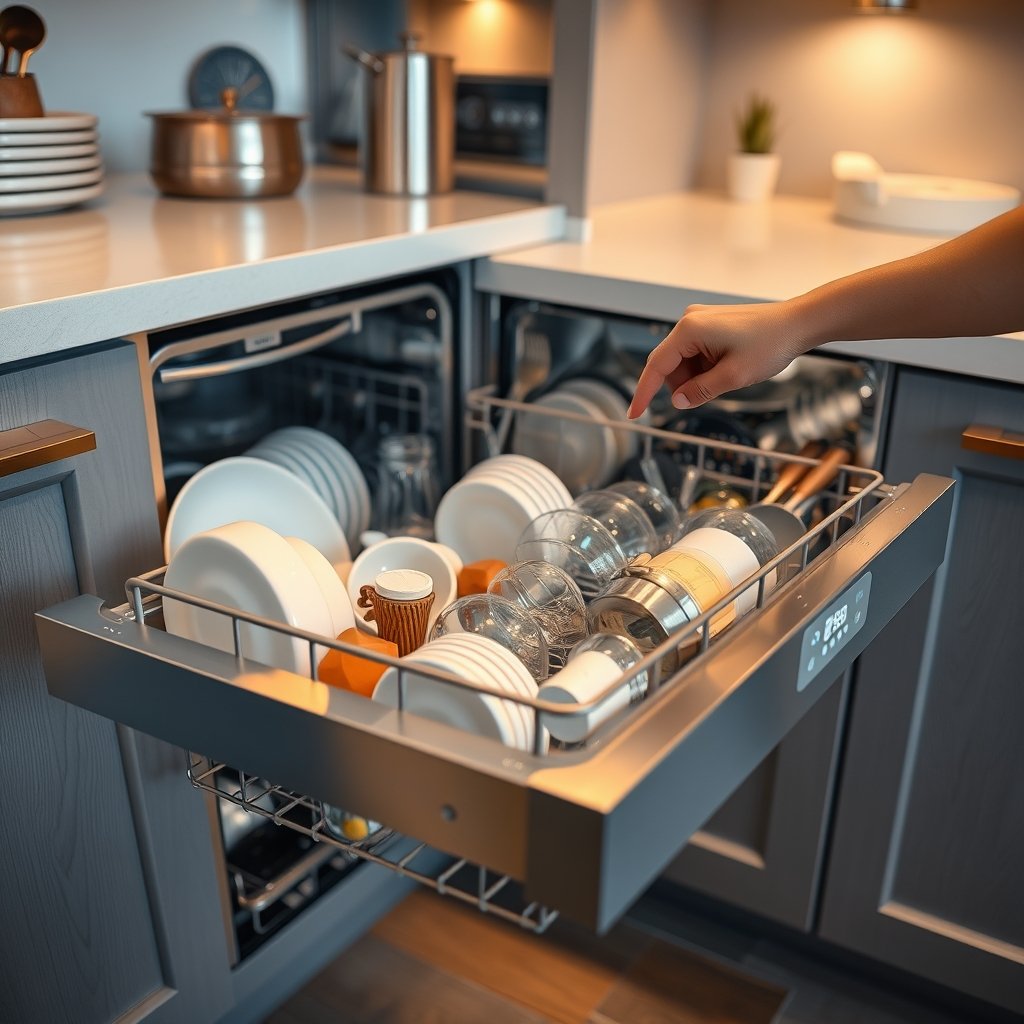
It’s not all positive. Drawer dishwashers almost always require professional fitting, especially if you need to modify cabinetry or run dedicated water/electric lines—installation costs can sometimes approach or even exceed the machine’s sticker price. For more details on similar compact solutions, explore our Portable Air Fryer picks or Induction Burner strategies.
For apartment renters, always check with your landlord about cabinet modification and electrical upgrades before purchasing, or opt for a portable unit or alternate counter appliance if landlord approval is uncertain.
Real‑World Performance: What Verified Fisher & Paykel Owners Report
Feedback from actual Fisher & Paykel DishDrawer owners shows clear trends. Users love the ergonomic design (no need to bend as far), improved access, and modern look. Still, these points repeat in verified reviews:
- Installation cost: Most units require cabinet modification and new plumbing/electrical, sometimes doubling the total upfront cost. This is especially true for under counter dishwasher drawer compact layouts with unique fits (source).
- Capacity limits: Single-drawer units struggle with large pots, pans, or heavily soiled items—expect to wash these by hand or run more cycles. If you’re a frequent cook or batch chef, a standard 24-inch dishwasher may serve you better. See capacity comparisons and tips to maximize space with a Multi Cooker for prep tasks.
- Reliability: Drawer systems, especially electronic panels and hinges, tend to require more service calls than conventional dishwashers. Owners report warranty claims more often, and out-of-warranty repairs cost more, especially for rare parts.
| Feature | Single Drawer | Two Drawer | Standard 24″ Dishwasher |
|---|---|---|---|
| Space needed | Minimal (fits almost anywhere) | Requires cabinet space for two drawers | Full 24" wide, full depth |
| Capacity | Best for singles/couples | Similar to standard tub, but split loads | Largest—suits families or batch cooking |
| Install cost | Higher per drawer; cabinet mods likely | Highest; extra lines and structure | Lowest; fits most 24" cabinet spaces |
| Energy/water use | Low on frequent small loads | Low–mid; can run one or both | Higher unless always fully loaded |
| Reliability | Moderate service demand | Higher (more moving parts) | Best; parts easily available |
Also, many owners point out the importance of correct installation. Three crucial (and commonly missed) steps for success:
- Precision cabinet cut-out and reinforcement for the drawer’s weight and shallower profile
- Dedicated water line, drain and 120V/240V electrical as close as possible—long hoses amplify noise and leak risk
- Level, vibration-isolated mounting plus back-panel sealing/venting for quiet, safe use (details matter)
For more real-world reliability and warranty tips, check our guide on Compact Espresso Machines or Cordless Stick Vacuums—the installation and service pitfalls are often similar in small spaces.
Before you commit, use this quick checklist:
- How often do you cook (and with what cookware)?
- What’s your true daily/weekly load size?
- Are you allowed to change cabinets and utilities where you live?
- What is your real budget (machine + install + possible repairs)?
Conclusion & Next Steps
For singles or couples in small apartments who value space and run frequent, light loads, a Dishwasher Drawer can be worth the investment—if you are ready for higher upfront and installation costs and you understand the real-life cleaning and service tradeoffs. For frequent cooks, families, or people who regularly wash large cookware, a standard 24-inch built-in remains the safer, more affordable choice. Always inspect your cabinet cut-out and utilities, get at least two installer quotes, and confirm with your landlord or contractor before buying. Ready to upgrade? Measure, compare, and choose the right fit—don’t forget to review multi-cooker or air fryer solutions for even more small kitchen options.
Dishwasher Drawer FAQ
Is a dishwasher drawer a good choice for apartments?
Yes, for singles or couples in small kitchens who mostly wash smaller loads and want to reclaim cabinet space, a dishwasher drawer is ideal. But if you often cook with large pots or serve more people, a standard 24-inch dishwasher is better.
What is the typical installation cost for a dishwasher drawer?
Expect to pay $400–$1,000+ extra for installation, depending on cabinet modifications, utility hookups, and your local labor rates. Always get a clear quote including possible upgrades before purchase.
Can renters install a dishwasher drawer?
Rarely, unless your landlord approves cabinet and utility changes. Portable dishwashers or countertop models are often a safer alternative for renters.
Do dishwasher drawers save money in the long run?
If you frequently run small loads, yes—water and energy savings add up over time. For large households or infrequent dishwashing, standard tub models are more cost effective.
Are Fisher & Paykel drawer dishwashers reliable?
They are top-rated for design and ergonomics but can require more service (especially with hinges and electronic controls) than traditional models. Extended warranties are recommended.
—